
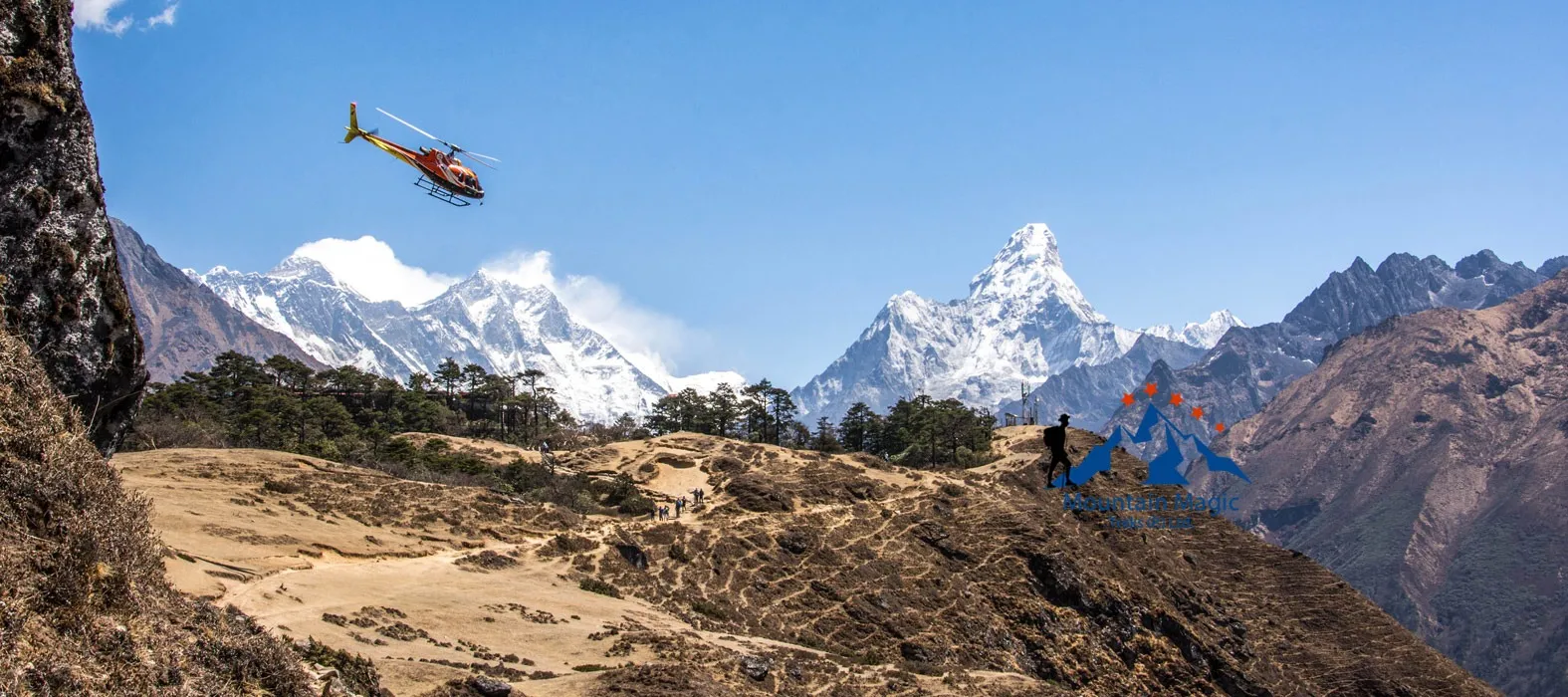
The Everest region is known for its high mountains, glaciers, and rocky landscapes. However, the route from Lukla to Everest Base Camp also passes through several different plant zones. Lower sections have forests, shrubs, and flowering plants, while higher areas become increasingly dry and exposed.
These changes are closely connected to altitude, temperature, soil, and the length of the growing season. During the Everest Base Camp Trek with Helicopter Return, travelers can notice how the landscape changes as the trail climbs from green valleys toward the upper Khumbu region.
Green Landscapes Around Lukla and Phakding
The lower part of the route has more vegetation than the areas near Everest Base Camp. Lukla and Phakding sit within a landscape that supports trees, shrubs, and smaller plants.
The presence of more moisture and relatively warmer conditions allows different types of vegetation to grow here.
Trees Along the Lower Trail
Depending on the exact location and season, trekkers may see:
- Pine and other conifer trees.
- Rhododendron plants.
- Broadleaf trees.
- Ferns and smaller woodland plants.
- Grasses growing beside open sections of the path.
These plants make some lower trail sections feel greener and more sheltered than the exposed terrain found farther uphill.
Forest Sections Between Phakding and Namche Bazaar
As the route continues toward Namche Bazaar, the trail passes through wooded areas and follows sections of the Dudh Koshi valley.
The vegetation can change from one side of the valley to another because sunlight, slope direction, moisture, and elevation influence plant growth.
Rhododendron and Pine Forests
Rhododendrons are especially associated with the Himalayan landscape. In spring, some varieties produce colorful flowers that stand out against the surrounding forest.
Pine and other conifers also appear in suitable areas. Their presence adds to the woodland character of the lower and middle sections of the route.
However, flowering times and the number of visible blooms depend on local conditions. Travelers should not expect every forest section to look the same throughout the year.
How the Landscape Changes Around Namche Bazaar
Namche Bazaar sits at approximately 3,440 meters. By this point, the route has gained considerable elevation from Lukla.
The surrounding slopes still support vegetation, but the conditions become more demanding for plant growth.
Why Plant Growth Becomes Different
Several factors influence vegetation around this elevation:
- Cooler temperatures.
- A shorter growing season.
- Differences in sunlight across slopes.
- Thin and rocky soil in exposed locations.
- Stronger winds in open areas.
Some slopes remain covered with trees and shrubs, while other sections have more open ground.
The Everest Base Camp Trek with Helicopter Return includes an acclimatization stop in Namche, giving travelers time to experience this transition before continuing toward Tengboche and Dingboche.
Flowering Plants Near Tengboche
The trail from Namche toward Tengboche passes through areas where forest vegetation remains an important part of the landscape.
Tengboche is situated at roughly 3,860 meters. Its surrounding hills include wooded slopes and open areas where smaller plants grow during suitable seasons.
Seasonal Flowers Along the Route
During warmer months, certain flowering plants may appear beside paths, clearings, and open slopes.
Rhododendron blooms are a familiar feature of spring in parts of the Himalayan region. Other small plants may also grow in sheltered locations.
Their appearance depends on altitude and local weather. A plant that flowers in one valley may bloom later at a higher location because temperatures develop differently.
Sparse Vegetation Around Dingboche
Dingboche lies at approximately 4,410 meters. Here, the landscape becomes more open, and large forest areas are less common.
The settlement is surrounded by mountain slopes, stone walls, and open terrain. Small grasses, low shrubs, and hardy plants can survive in suitable places.
Why Trees Become Less Common
Higher elevations create difficult conditions for trees. Low temperatures, strong winds, limited growing time, and shallow soil make it harder for many tree species to survive.
As a result, vegetation becomes shorter and less dense.
The change is not always sudden. Travelers may notice patches of greenery in sheltered areas alongside dry and rocky ground.
Plant Life Between Dingboche and Lobuche
The trail from Dingboche to Lobuche passes through increasingly exposed high-altitude terrain.
After leaving Dingboche, the route reaches the Dughla area and continues toward the memorials near Thukla Pass before approaching Lobuche.
Small Plants in a Harsh Environment
At these elevations, vegetation is limited. Some hardy grasses, mosses, and small alpine plants may grow where soil and moisture are available.
Large trees are generally absent from the higher sections.
The landscape becomes dominated by rocks, mountain slopes, and open ground. Plants that survive here must tolerate cold temperatures and a short period suitable for growth.
The Rocky Environment Around Gorakshep
Gorakshep sits at approximately 5,164 meters and serves as an important overnight settlement on the route to Everest Base Camp and Kala Patthar.
Vegetation is extremely limited in this high-altitude environment. Much of the surrounding landscape consists of rocky ground, glacial deposits, and exposed mountain terrain.
Why Green Cover Is Limited
At this elevation, plants face several challenges:
- Very low temperatures.
- Strong winds.
- Limited soil development.
- Short growing periods.
- Frequent exposure to snow and ice.
Only highly adapted forms of plant life can survive in suitable protected spots.
The contrast with the greener lower valleys is one of the clearest landscape changes along the route.
Why Vegetation Changes Matter to the Trekking Experience
Plant life is more than a visual feature. It helps travelers understand how different the environments are along the route.
Lower forest sections can provide shade and a sheltered walking environment. Higher sections are more open, with less natural protection from wind and sunlight.
The Everest Base Camp Trek with Helicopter Return follows this gradual change before reaching the high-altitude destinations near Gorakshep, Everest Base Camp, and Kala Patthar.
Observing these transitions gives travelers a clearer picture of the different natural conditions found within the Khumbu region.
Final Thoughts
The vegetation along the Everest Base Camp route changes gradually with altitude. Forests and flowering plants are more common around lower settlements, while grasses and small hardy plants become more important in higher areas. Near Gorakshep, exposed rock and glacial terrain dominate the landscape.
During the Everest Base Camp Trek with Helicopter Return, these changes offer a useful way to understand the natural environment of the Khumbu region. Looking closely at the plants along the trail also reveals how life adapts to some of the most demanding mountain conditions.
Frequently Asked Questions
1. Are there forests along the Everest Base Camp route?
Yes. Forested sections can be seen along parts of the lower and middle route, particularly around the areas between Phakding, Namche Bazaar, and Tengboche.
2. Can trekkers see rhododendron flowers?
Rhododendrons grow in parts of the Himalayan region. Spring is generally the best period for seeing their flowers, although blooming times vary with elevation and local weather.
3. Does vegetation continue near Lobuche?
Vegetation becomes very limited around Lobuche. Small hardy plants may survive in suitable locations, but large forests are absent.
4. Why are there fewer trees at higher elevations?
Lower temperatures, strong winds, shallow soil, and shorter growing seasons make it difficult for many tree species to survive at high elevations.
5. Is the landscape around Gorakshep mostly rocky?
Yes. The area around Gorakshep is largely characterized by exposed rocky terrain, glacial deposits, and high mountain landscapes, with very limited vegetation.